Tataouine
Tataouine
At the gateway to the Tunisian desert, Tataouine reveals its fortified ksars, troglodytic villages, and Star Wars filming sets in an atmosphere suspended in time.
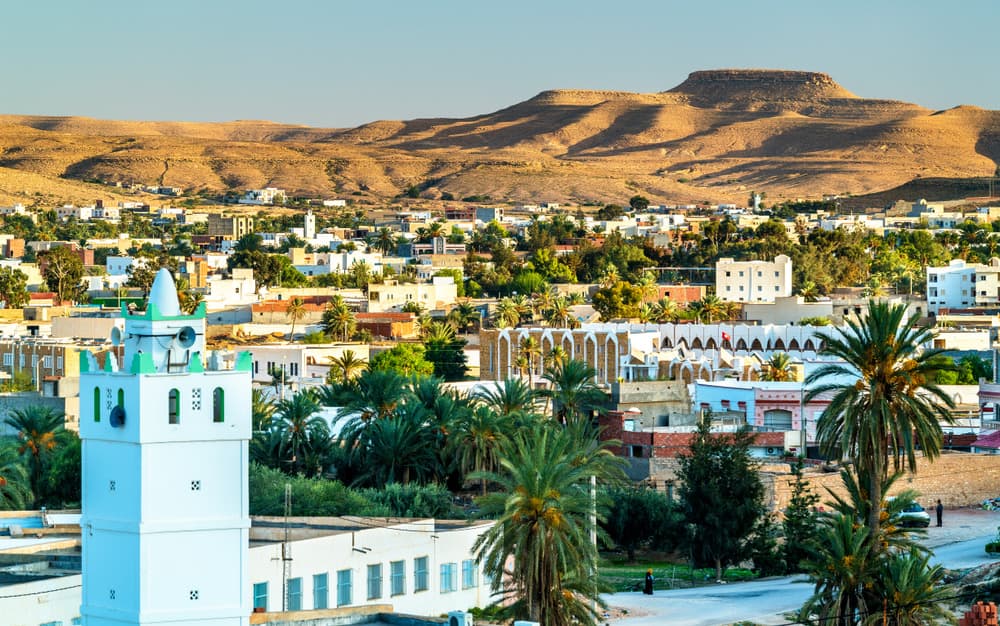
Renowned for its expression "going to Tataouine" (venturing to the ends of the earth), this small city of 60,000 inhabitants located approximately 500 km from Tunis offers the perfect opportunity for an off-the-beaten-path journey. Whether indulging in a traditional hammam scrub or simply wandering through the city's streets, Tataouine will captivate visitors with its undeniable authenticity.
Tataouine is equally celebrated for its delectable pastries, particularly the cornes de gazelles—pastries you absolutely must taste. Don't miss the chance to admire the architectural masterpieces of the southern ksars either.
A Glimpse of History
Literally meaning "water source" in Berber, the city was formerly called "Foum Tataouine." Its origins stem from a blend of Punic, Roman, Berber, and Arab-Muslim civilizations. Arabs from the Orient who settled in the plains near wells engaged extensively in agricultural activities. The ksars they constructed served to preserve all their harvest produce.
Strongly marked by colonization, Tataouine once represented an old French military detention camp. During the French occupation that began in 1882, colonists established an intelligence bureau and a souk, which opened a decade later. This sparked the opening of numerous markets throughout the city, as residents found it difficult to provision themselves as they wished. By 1898, Tataouine had acquired numerous structures, including a mosque, a municipal slaughterhouse, a grain market, and a butcher's stall. A post office, infirmary, and primary school followed shortly after.
Today
Tataouine endlessly reflects its characteristic charm. From a tourism perspective, the city serves as an excellent starting point for the ksar circuit tour, organized every Monday and Friday. The scene shifts at the open-air market, brimming with foodstuffs, spice varieties, multicolored fabrics, henna, jewelry, and magnificent artisanal products. Each March, Tataouine hosts the International Festival of Saharan Ksars, marked by festivities featuring artistic performances. Visitors never tire of admiring numerous equestrian spectacles and various cultural events.
This place so inspired filmmaker George Lucas with its name that he referenced it as Tatooine, a legendary planet he prominently featured in his screenplay.
Main Points of Interest
The city of Tataouine distinguishes itself through numerous sites steeped in myth and legend. This small town will undoubtedly impress visitors seeking new curiosities.
Aïn Dkouk Natural Reserve or Oued Dkouk
Spanning 5,800 hectares, Oued Dkouk describes a natural site located within the Tataouine governorate. This natural space boasts rich fauna and flora, ideal for tourist and educational excursions. The park was designated a natural reserve in 2009 and has been part of Tunisie's Ramsar sites since February 2, 2012.
The Mosque of the Seven Sleepers
This place of worship dating from 1920 distinguishes itself particularly for its slightly tilted minaret. Inside, one can admire walls adorned with numerous bas-reliefs. The legend associated with the site tells of 7 Christians hidden in a cave where they allegedly slept for nearly 400 years. The tombs located adjacent to the site have thus been considered the graves of the seven sleepers.
The City of Ghomrassen
According to legend, Ghomrassen derives from a combination of two names, Ghom and Rassi. Built above an ancient oasis, the city now constitutes a municipality of Tataouine. Numerous traces of Roman occupation vestiges are notably visible. Subdivided into several quarters, those of Ennasr, Ennakhil, Anouar, and El Jadid are well worth visiting.
The Villages
During your journey, the discovery of two villages in Tataouine offers an impressive setting. By their charm alone, the detour is absolutely worthwhile.
Douirat
This village is generally divided into two parts, including:
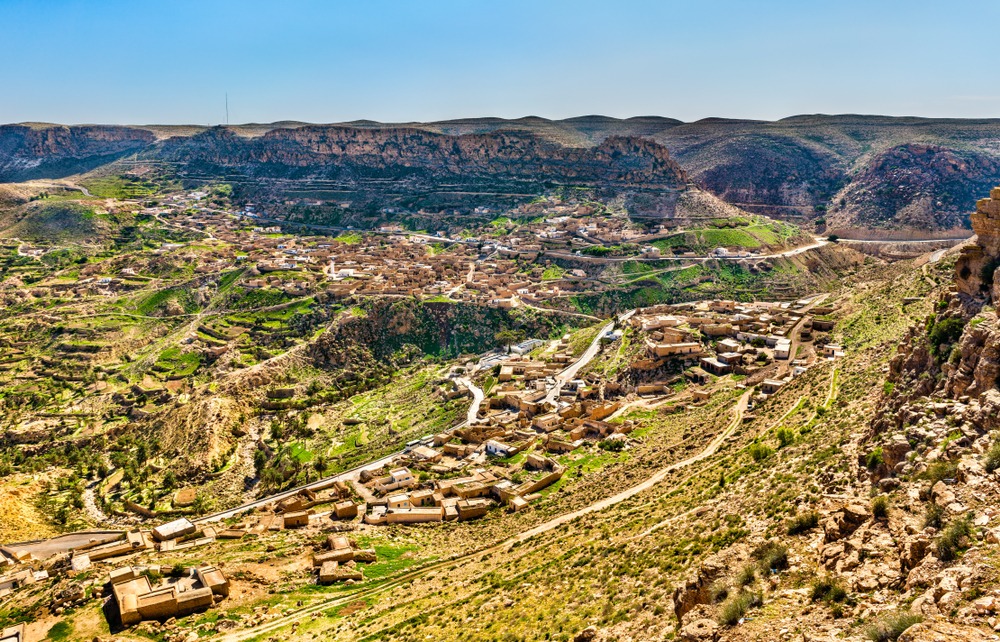
The old village, comprising numerous small dwellings called "ghiren," meaning "cave." The troglodytic inhabitants primarily lived from cultivating wheat, olives, and dates. These underground dwellings are said to have been constructed to serve multiple functions. Left abandoned, only a few vestiges marking the ancient Berber culture remain;
The new village, situated at the foot of the mountain, currently features contemporary housing. It appears to continually revive the image of the ancient settlement overlooking it.
Chenini
Located 20 km from Douirat, the village of Chenini presents a picturesque appearance. Its housing types reveal the same characteristics as its counterpart. It rises in elevation along a cliff face toward the summit, which in turn reveals the ruins of a ksar.
A Quick Detour to the Ksars
Within the villages of Tataouine themselves, you'll have the opportunity to discover magnificent ksars. Among them, the ksar ouled Soltane stands out as partially inhabited. It is the finest ksar granary. Entirely renovated in the late 1990s, it features two courtyards dating from the 15th and 19th centuries; the ksar ouled Debbab is today a hotel-museum complex; the ksar Hadada owes its reputation to having served as the filming location for the first Star Wars episode in 1997, titled "The Phantom Menace." Since then, the location has been converted into a guesthouse. Further south stands the ksar Megabla, which houses a museum. It contains a collection of fossils and representations of dinosaurs that once inhabited the region.
Practical Information
Climate
Tataouine experiences a desert climate according to the Köppen-Geiger classification. Notably, there is a very low precipitation rate with annual rainfall of 134 mm. Throughout the year, the average temperature rises to 20 °C and can reach 29 °C in July. The coldest month occurs in January, a period when days are extremely frigid.
Airplane travel remains the fastest and most comfortable mode of transportation, though fares can be quite expensive. Agencies offer services to reach the city of Tataouine, operating on the main rail axis Tunis-Sousse-Sfax-Gabès-Tataouine. This is a train-bus connection where the entire journey takes approximately nine hours.
In Tataouine as in Tunis, taxi and bus represent the most popular public transportation. The difference lies in pricing. Alternatively, you can rent a car to visit the various sites.
Attractions in Tataouine
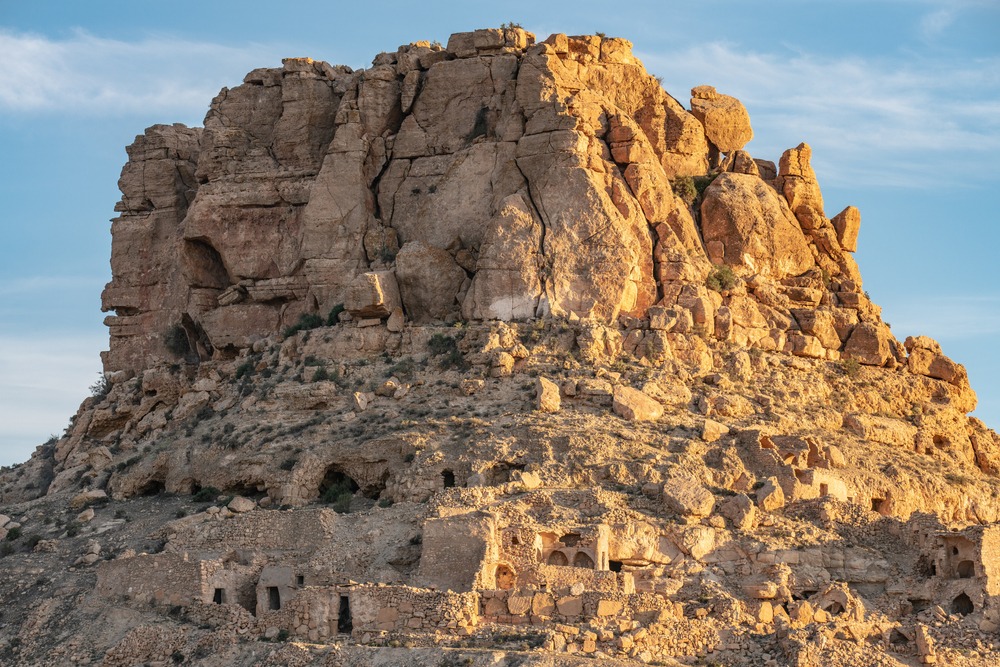
Guermassa
Ancien village berbère fortifié du Dahar, Guermassa associe ksar du XIIe siècle, habitations troglodytes et mosquée des années 1940, à une trentaine de kilomètres de Tataouine.
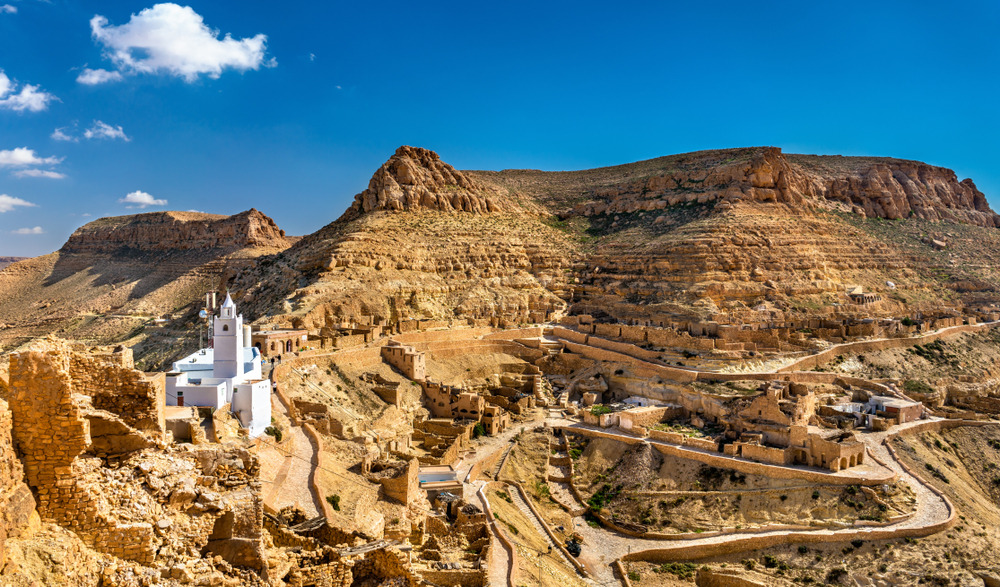
Chenini
Village berbère troglodyte à 18 km de Tataouine, Chenini aligne ksour du 12e siècle, mosquée blanche perchée et tombeaux légendaires sur une crête rocheuse.
Want to discover this destination?
Our local advisors design your tailor-made trip.