Old Town of Tozeur (Ouled el-Hadef)
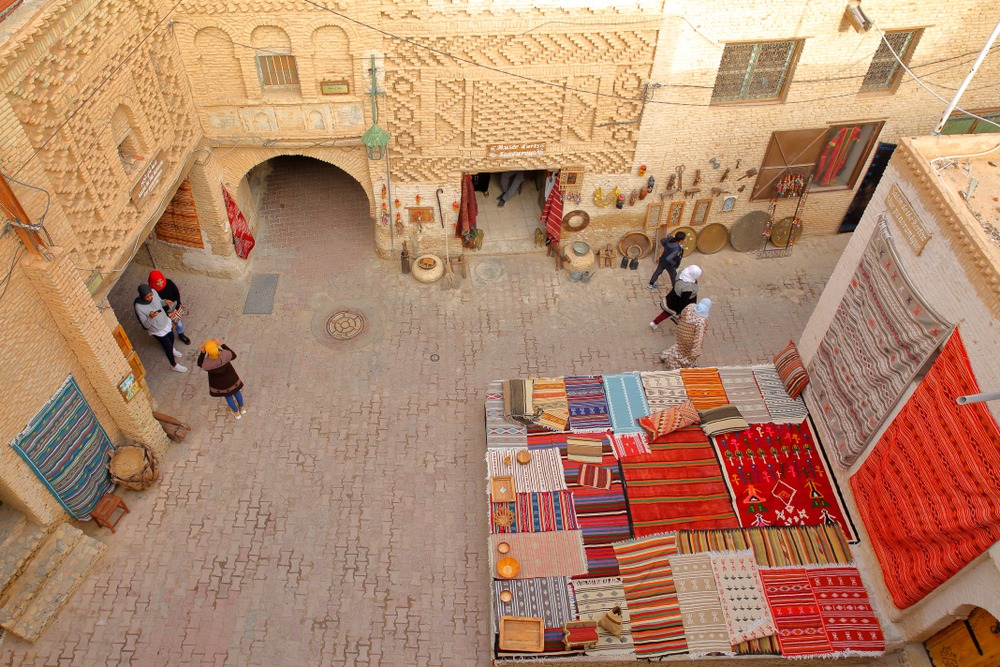
Ouled el-Hadef, the historic heart of Tozeur, reveals ochre brick facades with raised geometric patterns, testament to Djerid architecture spanning several centuries.
At the heart of Tozeur, the historic quarter of Ouled el-Hadef preserves one of the Maghreb's most cohesive terracotta brick architectures. Built between the 14th and 17th centuries, this maze of narrow alleyways unveils facades with raised geometric patterns, a technique unique to the Djerid region. Here unfolds the story of a prosperous oasis city, a crossroads of trans-Saharan trade routes.
Essentials at a Glance
- Access: Quarter accessible on foot from Tozeur's city centre, Habib Bourguiba avenue.
- Admission: Free entry to public alleyways.
- Recommended duration: 1.5 to 2 hours for a leisurely exploration.
- Dress code: Modest clothing recommended; cover shoulders and knees near mosques.
- Accessibility: Limited — narrow paved alleyways with frequent elevation changes.
What to See
The defining feature of Ouled el-Hadef is its ochre-yellow brick worked into raised patterns: lozenges, chevrons, interlacing designs. Each facade forms a unique decorative panel. The alleyways narrow sometimes to barely permit two people to pass. Within them are inward-facing courtyard houses, small neighbourhood mosques and ancient fountains.
History and Context
Tozeur developed as a major caravan stopover linking sub-Saharan Africa to the Mediterranean coast. The quarter of Ouled el-Hadef — "the children of the target" — takes its name from a founding tribe. The raised brick technique, known as Djerid style, is documented from the 14th century onwards and ranks among Tunisie's remarkable architectural practices. Ibn Khaldoun, the great historian, was born in Tunis but travelled through the Djerid region, of which Tozeur was the intellectual centre.
Highlights of Your Visit
The Geometric Brick Facades
Observe the relief panels above doorways and between windows. Each pattern is assembled brick by brick with no visible mortar. Raking light in early morning or late afternoon reveals the full depth of the work.
The Zaouïa of Sidi Bou Aïssa
This discreet Sufi sanctuary, nestled within the quarter, illustrates Tozeur's spiritual role along caravan routes. Access to the interior may be restricted to non-Muslims depending on the time.
Dar Cheraït Museum (nearby)
Just outside the historic quarter, this private museum recreates scenes of traditional Djerid life within a neo-traditional palace. A useful complement to contextualise what you encounter in the alleyways.
Etiquette and Visiting Guidelines
- Avoid photographing residents without explicit permission.
- Stay within public alleyways; closed doors mark private dwellings.
- Keep voices low near mosques and zaouïas, especially during prayer times.
- Cover shoulders and knees if entering a place of worship.
Photography Tips
The golden morning light (one hour after sunrise) is ideal: it strikes the brick facades at a low angle and brings out the raised geometric patterns. At midday, overhead light flattens the details. Given the narrow alleyways, a wide-angle lens (24–28 mm) eases composition. Avoid flash, which erases texture.
Location and Access
Ouled el-Hadef lies to the northwest of Tozeur's city centre, a few minutes' walk from the main avenue. Tozeur is accessible by air (Tozeur-Nefta airport), by road from Tunis (approximately 450 km) or by shared taxi from Gafsa or Gabès. No public transport within the quarter itself — exploration is entirely on foot. Local guides offer guided tours departing from downtown hotels.
Nearby Attractions
- Tozeur Oasis — the palm grove bordering the city, with its traditional irrigation channels.
- Chott el-Jérid — the great salt lake, a few kilometres away, with spectacular mirages in summer.
- Nefta and its Basin — neighbouring town renowned for its Sufi mysticism and its own bowl-shaped palm grove.
- Dar Cheraït Museum — recreation of traditional Djerid life, in Tozeur itself.
Frequently asked questions
Autumn (October–November) and spring (March–April) offer pleasant temperatures. Summer regularly exceeds 40 °C in the Djerid; if visiting in July–August, start early in the morning.
The quarter can be explored freely without a guide. However, a local guide adds valuable historical context and facilitates access to certain semi-private spaces.
Yes. Spend the morning in the old town, then head to Chott in early afternoon. Mirages are more visible at midday in intense heat.
The narrow paved alleyways are well suited to walking with young children on foot. Pushchairs are however difficult to manoeuvre over uneven paving.
A few workshops and small shops offer carpets, pottery and Djerid dates. Prices are generally more affordable than in tourist zones, though haggling is expected.
Interested in this visit?
We can include it in your personalised itinerary.