Bulla Regia
Bulla Regia
Roman archaeological site near Jendouba, Bulla Regia is renowned for its homes with underground levels, in situ mosaics and a remarkably well-preserved ancient urban complex.
In north-western Tunisie, close to Jendouba, Bulla Regia preserves the remains of a Berber, Punic and then Roman city known for its semi-underground dwellings, designed to escape the summer heat. The site stands out for its in situ mosaic floors, its temples, theatre and forum, complemented by major pieces now displayed at the Bardo Museum in Tunis.
Why visit Bulla Regia
Bulla Regia distinguishes itself from other Roman sites in North Africa through a unique feature: its houses with underground levels, organised as a replica of the upper storey, allowed residents to live at cool temperatures during the hottest months. Several of these dwellings have retained their mosaics in place, which makes the visit particularly evocative for understanding daily life in a Roman provincial city.
Beyond the houses, the site offers a complete panorama of ancient urban planning: forum, capitol, Temple of Apollo, Christian basilicas, theatre, baths, market and amphitheatre unfold across a single perimeter, in a quiet rural setting.
History of Bulla Regia
The site's occupation predates the Punic period. The megalithic necropolis located south of the archaeological park, with its Neo-Punic stelae and shaft tombs, bears witness to ancient Berber settlement. Excavations have also uncovered Greek pottery dating to the 4th century BC.
In the 3rd century BC, the city came under Carthage's influence, as evidenced by inscriptions linked to the cult of Baal Hammon and burials in Punic-type funerary vessels. After the Second Punic War, around 203 BC, it entered the Roman orbit. It subsequently became the capital of Massinissa's Numidian kingdom, earning it the title Regia (royal).
In 46 BC, following the Battle of Thapsus, Julius Caesar reorganised the province of Africa. Bulla Regia, having remained neutral in the conflicts that troubled Rome, received the status of free city and retained its territory and traditional political institutions, unlike other neighbouring cities which welcomed veteran colonies.
The city became entirely Christianised from 399 onwards, when Saint Augustine delivered a famous sermon there, in which he reproached the inhabitants for their excessive taste for spectacles. Under the Byzantine Empire, after Arian persecution during the Vandal period, the city experienced gradual decline.
What to see on the site
The underground houses
Three emblematic dwellings structure the visit and illustrate the characteristic private architecture of Bulla Regia:
- The House of the Hunt, with its peristyle and vaulted underground rooms
- The House of Amphitrite, which preserves a mosaic depicting the sea goddess surrounded by centaurs
- The House of the Treasure, so named for the coins discovered during excavations
Each underground storey replicates, on a reduced scale, the layout of the upper level, allowing occupants to descend to cool rooms during the summer.
The forum, capitol and Temple of Apollo
The forum, the central public square, was bordered by the capitol, the civil basilica and the Temple of Apollo. The capitol, to the west of the forum, survives only as a foundation. The Temple of Apollo, rebuilt in the 3rd century, features three adjoining sanctuaries, a spacious cella and a colonnaded courtyard: a plan considered representative of African religious architecture during the Roman period.
The Christian basilicas
Excavations conducted between 1952 and 1954 uncovered two Christian basilicas with three naves, adorned with mosaics. The larger one is thought to have housed relics attributed to Saint Stephen, in a building dated to the 6th century.
The theatre, baths and amphitheatre
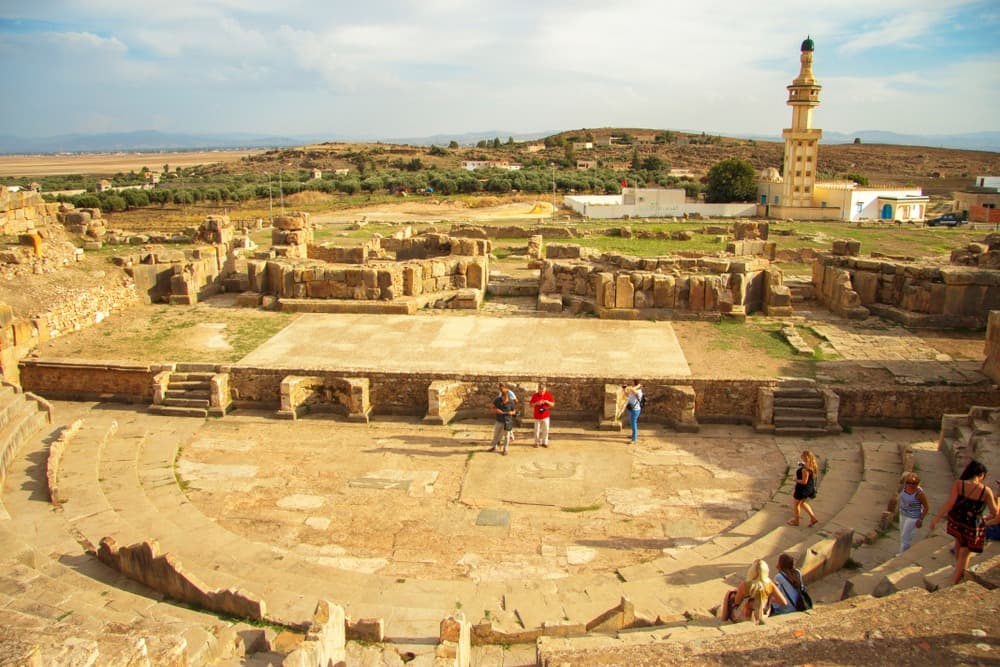
The theatre, built under Marcus Aurelius and Lucius Aurelius Verus and later renovated in the 5th century, is the best-preserved leisure building. It was in this setting that Saint Augustine is believed to have delivered, around 399, his sermon against the Bullenses' taste for spectacles. Four baths from the 3rd century have been identified, some remaining in use over an extended period. The amphitheatre, by contrast, reveals only severely damaged remains.
The market
At the exit from the forum, the 3rd-century market presents itself as a rectangular building bordered by a colonnade, with an apse on one of its sides.
Practical information
The site is open year-round, generally from morning to late afternoon, with more restricted hours in winter. Entry is charged at a moderate rate, with the usual additional fee for photography. Allow 2 to 3 hours to tour all the remains at a leisurely pace.
- Wear sturdy footwear: the terrain is uneven and rocky
- Bring water, a hat and sunscreen: shade is scarce
- A small museum on site complements the visit
- The presence of a local guide is helpful for spotting in situ mosaics
When to visit Bulla Regia
The site is explored outdoors and the Tunisian summer can be challenging there, with temperatures frequently exceeding 35°C in July and August. The most pleasant periods are spring (March to May) and autumn (September to November), when the heat is manageable and the light favourable for photography. Winter remains passable but days are shorter and sometimes rainy in this north-western region. If visiting in summer, favour early morning or late afternoon.
How to get there
Bulla Regia is located approximately 8 km north of Jendouba, on the road to Aïn Draham. From Tunis, allow around 2.5 to 3 hours by car via the A3 motorway, then the national road. Jendouba is also served by train from Tunis, with several daily connections; from the station, a taxi will get you to the site quickly. A rental car remains the most flexible solution for combining Bulla Regia with other sites in the region.
What to see nearby
Bulla Regia fits easily into a Tunisian cultural itinerary. In Tunis, the Bardo Museum holds the major mosaics from the site and complements the visit. Further south, the Berber village of Chenini offers another example of troglodytic habitat adapted to the climate. To extend your exploration, Sidi Bou Saïd and the Chebika oasis rank among the classic stops.
Frequently asked questions
Frequently asked questions
Allow 2 to 3 hours to tour the main underground houses, the forum, theatre and baths. With a guide or a deeper interest in archaeology, the visit can extend to a half-day.
With the summer climate in north-western Tunisie being very hot, residents designed a buried storey replicating the layout of the upper level. This arrangement offered cool rooms in summer and more temperate ones in winter.
Some mosaics remain in situ in the underground houses, notably in the House of Amphitrite. The most remarkable pieces are displayed at the Bardo Museum in Tunis.
Yes, by train from Tunis to Jendouba, then by taxi for the remaining 8 km. A car is nonetheless the most convenient way to explore at your own pace and combine with other stops in the north-west.
Spring and autumn offer the best conditions, with mild temperatures and lush vegetation. Summer is very hot and shade is scarce on the site.
Plan your visit to Tunisie
Bulla Regia fits naturally into a circuit combining ancient heritage, Berber villages and Saharan oases. To build a bespoke itinerary including this site and other stops in the north-west, consult our Tunisie travel suggestions.
Interested in this visit?
We can include it in your personalised itinerary.