Cap Bon and Sahel
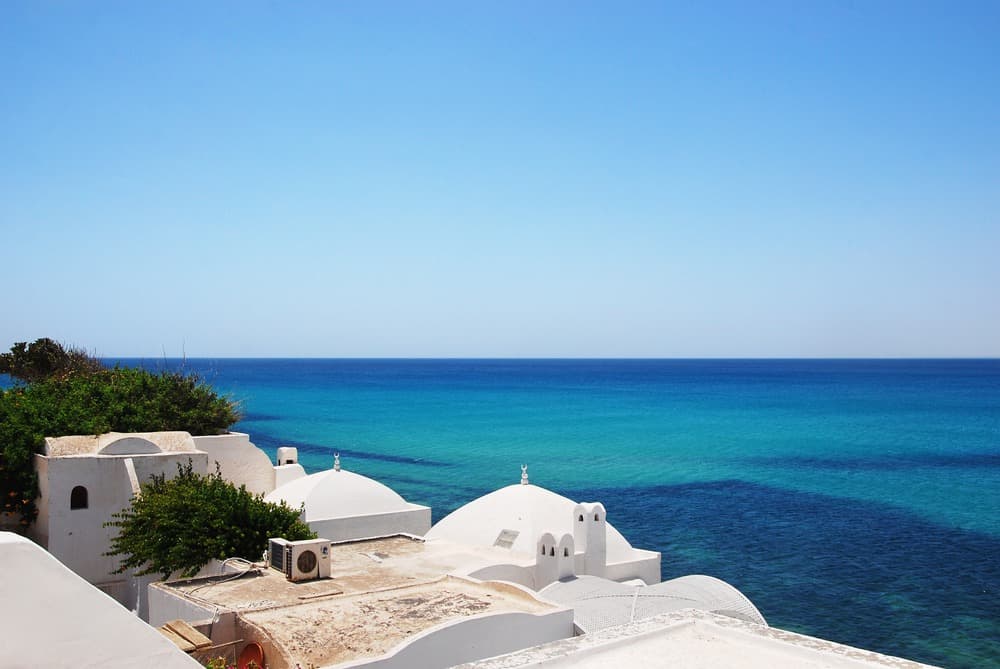
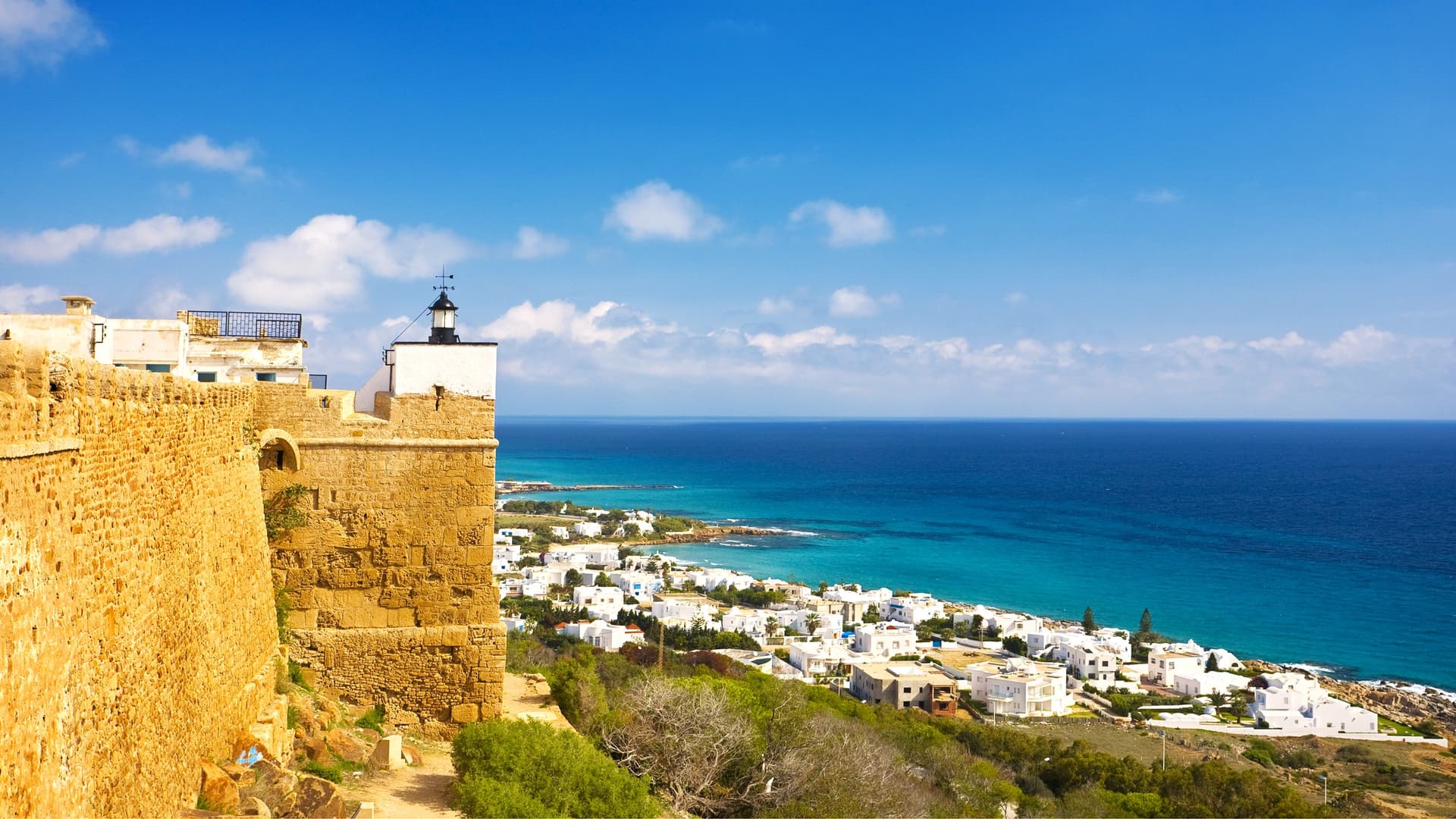
The eastern facade of Tunisie, where the fortified medinas of Sousse and Mahdia succeed each other between Sahel olive groves and citrus orchards of Cap Bon.
Cap Bon and Sahel form the eastern facade of Tunisie, a coastal strip of roughly 250 kilometres descending from the Cap Bon peninsula down to Mahdia. Our team has been organising itineraries along this coast for many years, and we see it as two regions bound by the sea: to the north, the agricultural and rolling Cap Bon, its citrus orchards around Menzel Bouzelfa and its Grombalia vineyards; to the south, the Sahel of olive groves, where the road between Sousse and Sfax crosses centuries-old plantations planted in quincunx pattern on limestone.
Hammamet opens the sequence on the northern side. The old fortified town and its 15th-century kasbah overlook a fine sandy beach, but it is heading north towards Kelibia and El Haouaria that Cap Bon truly reveals itself. Kelibia, a fishing port dominated by its Byzantine fortress, looks towards Sicily just 140 kilometres away. At El Haouaria, the ancient Roman quarries of Ghar el Kebir hollow out the cliff in the form of underground cathedrals: the stone extracted here was used to build Carthage. The Punic archaeological site of Kerkouane, UNESCO-listed, preserves the floor plans of Phoenician houses with their terracotta bathtubs—one of the rare Punic remains not covered over by the Romans.
Nabeul, the administrative capital of Cap Bon, lives by pottery and orange blossom distillation. The Friday market there remains a landmark for yellow and green enamelled ceramics. Further south, the coastline simplifies: long beaches, Sahline salt pans, lagoons. Sousse marks the entrance to Sahel proper. Its 9th-century fortified medina, the ribat and the Aghlabid Great Mosque bear witness to its role as a coastal stronghold against Byzantine incursions. Monastir, 20 kilometres to the south, lines its white ribat facing the sea—one of the oldest in the Maghreb (796). Mahdia closes the sequence: the former Fatimid capital founded in 921, the town extends to the cape where the Ras Mahdia lighthouse watches over the lampara fishermen who still set out at night for sardine.
The local economy rests on three pillars: fishing (Mahdia is the country's leading sardine port), olive growing (Sahel produces nearly half of Tunisie's olive oil) and seaside tourism concentrated on Yasmine Hammamet, Port El Kantaoui and the Skanès hotel zone. This latter dimension shaped the coastal landscape from the 1970s to 2000s, but it remains confined to specific pockets. Once you move 5 kilometres inland, you find olive grove villages like Ksar Hellal or Moknine, where textile and jewellery traditions are still passed down in workshops.
On the dining front, the region has its signatures: whole fish grilled with salt, ojja with merguez, egg briks from Nabeul, green mloukhia from Sahel simmered for hours. In Mahdia, port-side restaurants serve the morning catch without a menu—you choose your fish at the counter. The annual Ulysses festival in Kelibia (August) and the international festival of Hammamet (July-August, in the open-air theatre of the Sebastian villa) punctuate the cultural summer.
For the traveller, Cap Bon and Sahel offer a rare combination in Tunisie: seldom-visited archaeological sites (Pupput, Kerkouane, Thapsus), inhabited medinas, a workable maritime facade from May to October, and a dense road network that makes travelling swift. It is also the region best equipped for travellers wanting to alternate cultural days with quieter days by the sea.
To discover
Punic site of Kerkouane. Floor plans of 5th-century BC Phoenician houses on a cliff face, with mosaics of Tanit symbols. The only Tunisian Punic site not covered over by the Romans, UNESCO-listed.
Roman caves of El Haouaria. Ancient underground quarries of soft sandstone that were used to build Carthage. You descend by staircases cut into the rock, light falls in beams from the extraction shafts.
Medina and ribat of Sousse. 9th-century Aghlabid fortified complex, still inhabited. From the ribat tower, a sweeping view over white rooftops and the port. The Great Mosque can be visited outside prayer times.
Mahdia fishing port. The country's leading sardine port. Night-time outings possible with lampara boats in June-July, returning at dawn with crate unloading on the quay.
Pottery workshops of Nabeul. Potters' quarter where green and yellow enamels inherited from Andalusia are perpetuated. Workshop visits with traditional kiln and wheel-throwing demonstration.
When to go
The most comfortable season spans April to June, then September to October. Temperatures range between 22 and 28°C, the sea already reaches 21°C in May and stays at 24°C until late October. This is our preferred window for combining site visits and beach days without crowds. July and August concentrate Tunisian and European holidaymakers, temperatures rise to 32-34°C on the coast, the sea exceeds 26°C, but Hammamet, Sousse and Monastir are saturated and accommodation prices double. In this season, we tend to orient our travellers towards Kelibia, El Haouaria and Mahdia, which remain quieter.
From November to March, the air drops to 12-17°C during the day, the sea falls to 15°C. It rains little (60 to 80 mm per month on average), but wind can be strong at the Cape Bon point. This is an interesting season for archaeological sites: Pupput, Kerkouane and Thapsus can be visited almost alone, and the medinas regain their local rhythm. January and February are the wettest months, to be avoided if you are counting on swimming.
Practical advice
Four to six days are enough to traverse the region from Hammamet to Mahdia without rushing. Entry is via Tunis-Carthage airport (Hammamet is 65 km away, 1 hour's drive) or Monastir-Habib Bourguiba airport (10 minutes from the centre), well served by European charter flights. The A1 motorway connects Tunis to Sfax via Hammamet, Sousse and M'saken, making journeys swift: Tunis-Sousse in 1h45, Sousse-Mahdia in 1 hour. The interior Cap Bon network (Kelibia, El Haouaria, Kerkouane) requires a car—distances are short but secondary roads require one.
The region combines logically with Tunis and Carthage at the beginning or end of your stay, and with Kairouan and the centre, 1h30 from Sousse, to add a religious and caravan dimension. For a longer itinerary, the sequence Cap Bon – Sahel – Kairouan – Sahara works well over two weeks. Hotel comfort is high throughout the coast, with a range from guesthouses in Mahdia's medina to Yasmine Hammamet resorts. The region suits families (equipped beaches, short distances), archaeology and crafts enthusiasts, and travellers wanting a first encounter with Tunisie without heavy logistics.