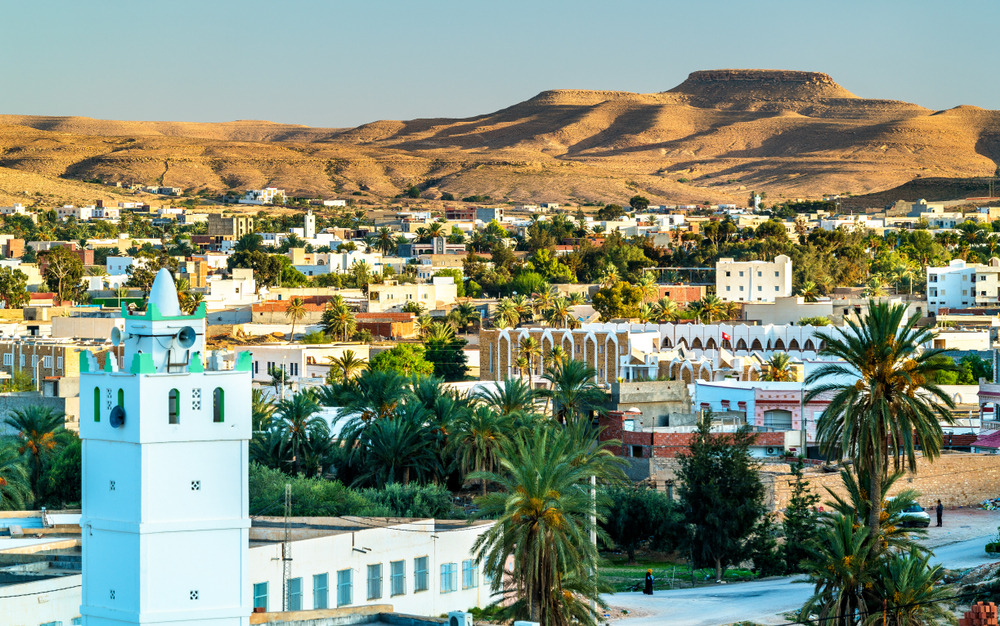
Le Kef
Perched at 780 meters altitude, Le Kef layers an Ottoman kasbah, Byzantine basilica and living medina atop a site inhabited since antiquity. A city off the beaten path, rich with a thousand years of history.
Le Kef is a mountain town in northwestern Tunisia, perched at approximately 780 meters altitude on the flanks of Jebel Dyr. An ancient Berber, Punic and Roman city, it preserves an Ottoman kasbah, early Christian basilicas and a still-inhabited medina. Less frequented than Tunis or Sousse, it offers a direct reading of Tunisian history spanning several millennia, set within a landscape of rolling hills and golden light.
Practical information at a glance
- Access: approximately 175 km west of Tunis via RN5; shared taxi connections from Tunis-Bab Saadoun and from Jendouba.
- Recommended duration: a full day for the medina, kasbah and main monuments; two days to explore the surrounding area.
- Dress code: modest dress recommended in the medina and mandatory to enter mosques.
- Altitude: bring an extra layer in winter, temperatures can drop below freezing.
What to see
The Ottoman kasbah dominates the town from a rocky outcrop; its ramparts enclose an interior courtyard and offer panoramic views over the surrounding hills. Below, the medina preserves narrow streets, patio houses and several zaouïas. The Dar El Kous basilica, a former Byzantine church converted to other uses, and scattered Roman remains testify to the historical density of the site.
History and context
Known as Sicca Veneria during the Roman era, the city was a religious center dedicated to Venus and a recruitment ground for Carthaginian mercenaries. It subsequently passed to the Byzantines, Arabs, Hafsids and Ottomans, each period leaving a legible architectural imprint. In the nineteenth century, Le Kef was a strategic stronghold during resistance to French colonization.
Highlights of your visit
The kasbah
Built primarily during the Ottoman period on earlier foundations, the kasbah today houses a regional museum dedicated to the arts and popular traditions of northwestern Tunisia. The ramparts afford clear views over the lower town and the plains beyond.
The Dar El Kous basilica
This early Christian basilica, among the best preserved in Tunisia, dates from the fourth or fifth century. Its apse and columns of local stone still stand. Access is from the upper medina, a few minutes' walk from the kasbah.
The zaouïa of Sidi Bou Makhlouf
A seventeenth-century sanctuary dedicated to a local saint, recognizable by its white domes and octagonal minaret. The interior is richly decorated with tilework and stucco. An active pilgrimage site, it remains open to non-Muslim visitors outside prayer times.
The Roman cisterns
Several Roman underground cisterns are visible throughout the town; some were reused in later periods. They testify to the importance of water management in this semi-arid mountain town.
Etiquette and visiting rules
- Remove shoes before entering the zaouïa of Sidi Bou Makhlouf.
- Shoulders and knees covered for both men and women in all places of worship.
- Ask permission before photographing residents in the medina.
- Avoid visiting mosques and zaouïas during Friday prayer hours.
Photography tips
Morning light is ideal from the kasbah ramparts: it illuminates the medina and hills without backlighting. The white domes of Sidi Bou Makhlouf stand out well in late afternoon. The narrow, shaded streets of the upper medina photograph best between 10am and 2pm when overhead light penetrates between the buildings.
Location and access
Le Kef is located in the governorate of the same name, near the Algerian border. The bus station and shared taxi terminal are located in the lower town. From Tunis, allow approximately two and a half hours by car. The town is accessible by private car or shared taxi; no direct rail connection is available. The upper medina is largely pedestrian and features steep gradients, making it challenging for people with reduced mobility.
Nearby attractions
- Dougga — Roman site listed as Unesco world heritage, approximately 70 km southeast of Le Kef.
- Jendouba — plains town and departure point for Bulla Regia, approximately 60 km north.
- Bulla Regia — Roman archaeological site famous for its houses with underground rooms, approximately 70 km north.
- Aïn Draham — mountain village surrounded by cork oak forests, approximately 80 km northwest.
Frequently asked questions
Spring (March-May) and autumn (September-November) offer pleasant temperatures. Summer is warm but manageable thanks to the altitude. Winter can be cold and rainy, even snowy.
It's possible by car, but ambitious: Dougga alone deserves two to three hours. Plan an overnight stay in Le Kef to visit both sites without rushing.
Yes, outside prayer times. Covered dress and removal of shoes are mandatory. It is advisable to visit in the morning or early afternoon.
A few hotels and guesthouses are available in town. The offer remains modest; booking in advance is recommended during peak season or local festivals.
The upper medina is essentially pedestrian. It is preferable to park your vehicle in the lower town and walk up. The streets are narrow and often steep.
Photography is generally permitted in the courtyard and on the ramparts. Inside the museum, check the rules posted at the entrance; some rooms may restrict photography.
Want to discover this destination?
Our local advisors design your tailor-made trip.