Kairouan
Kairouan
The fourth holy city of Islam, Kairouan captivates with its UNESCO medina, its 9th-century Great Mosque, and its legendary carpet workshops.
Kairouan, after Mecca, Medina, and Jerusalem, holds the distinction of being the fourth holiest city in Islam. Revered by Muslims and equally cherished by travelers, the city enchants with a unique medina, while its Great Mosque stands as a timeless masterpiece of universal architecture. The city's numerous artisan workshops, where the country's finest hand-knotted carpets are crafted, are equally unmissable. Situated approximately 150 km from Tunis, Kairouan is an essential destination for your vacation in Tunisie.
History
Following Basrah, Kufa, and Al-Fustat, Kairouan was the fourth city built by Muslims. Its founding dates back to 670, under the leadership of Oqba Ibn Nafi. Kairouan served as a crucial outpost for Muslim expansion across North Africa. In the 9th century, under the Aghlabid dynasty, it became the capital of Ifriqiya (a region of North Africa during the medieval period).
Despite the harsh, untamed landscape inhabited by wild beasts, Kairouan's inland location provided refuge from assault. Its distance from the sea protected it from Byzantine attacks. The surrounding mountains were Berber territory, and these tribes had allied with the Greeks to counter Arab forces. Thus, Kairouan functioned both as an outpost of holy war and as a defense for newly conquered lands.
Abou Qurra took possession of Kairouan in 775 and propagated Sufi Kharijism. Gradually, he extended his dominion throughout Tunisie and expelled all other conquerors. At its height in the 9th century, Kairouan was established as the capital of the Maghreb. It became a trading hub in the Mediterranean basin and a seat of learning featuring a medical school and a Maliki law school.
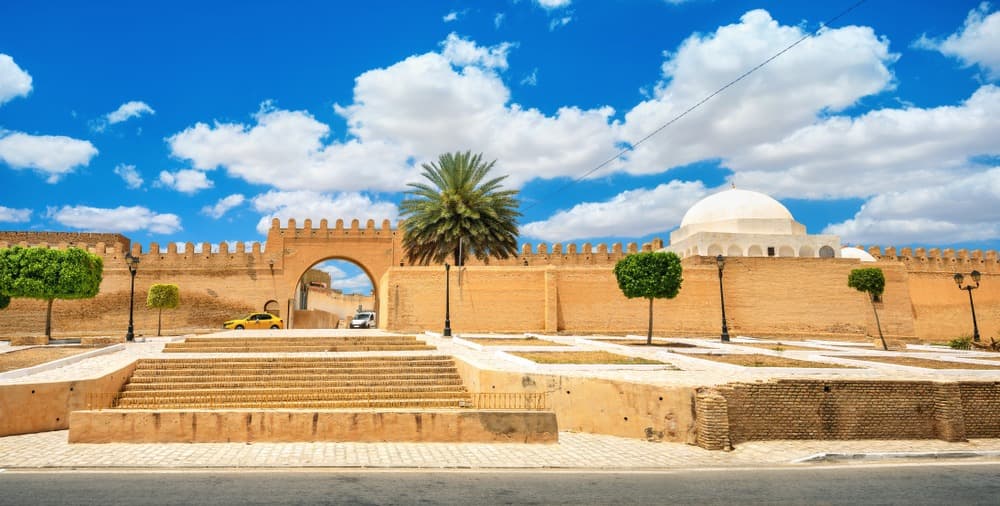
In 909, the city relinquished its capital status to Mahdia under the Fatimid dynasty. Abu Yazid briefly captured both cities before the Fatimids reclaimed them. In 1057, the Hilalians destroyed Kairouan. Many centuries passed before Hussein I Bey undertook restoration of the ramparts and several mosques in 1702. During the French colonial period, the city became one of the focal points of nationalist resistance.
Discovering Kairouan
Into the heart of Kairouan's medina
The medina is accessed through a monumental gateway. Immerse yourself in the world of bustling souks and street vendors. Wander through narrow alleyways lined with white-washed buildings and blue doorways. The setting and atmosphere transport you back through time. Climb the ramparts encircling the old city for sweeping views of the domes below. Continue your souk experience where merchants display their carpets with remarkable creativity. Don't miss the Barrouta Well, a site venerated for generations. Water is drawn using an ancient system of wheels and buckets set in motion by a camel walking in circles. As you leave the medina, head toward the Aghlabid Basins, remnants of a vast hydraulic complex from the 9th century.
Treasures to uncover
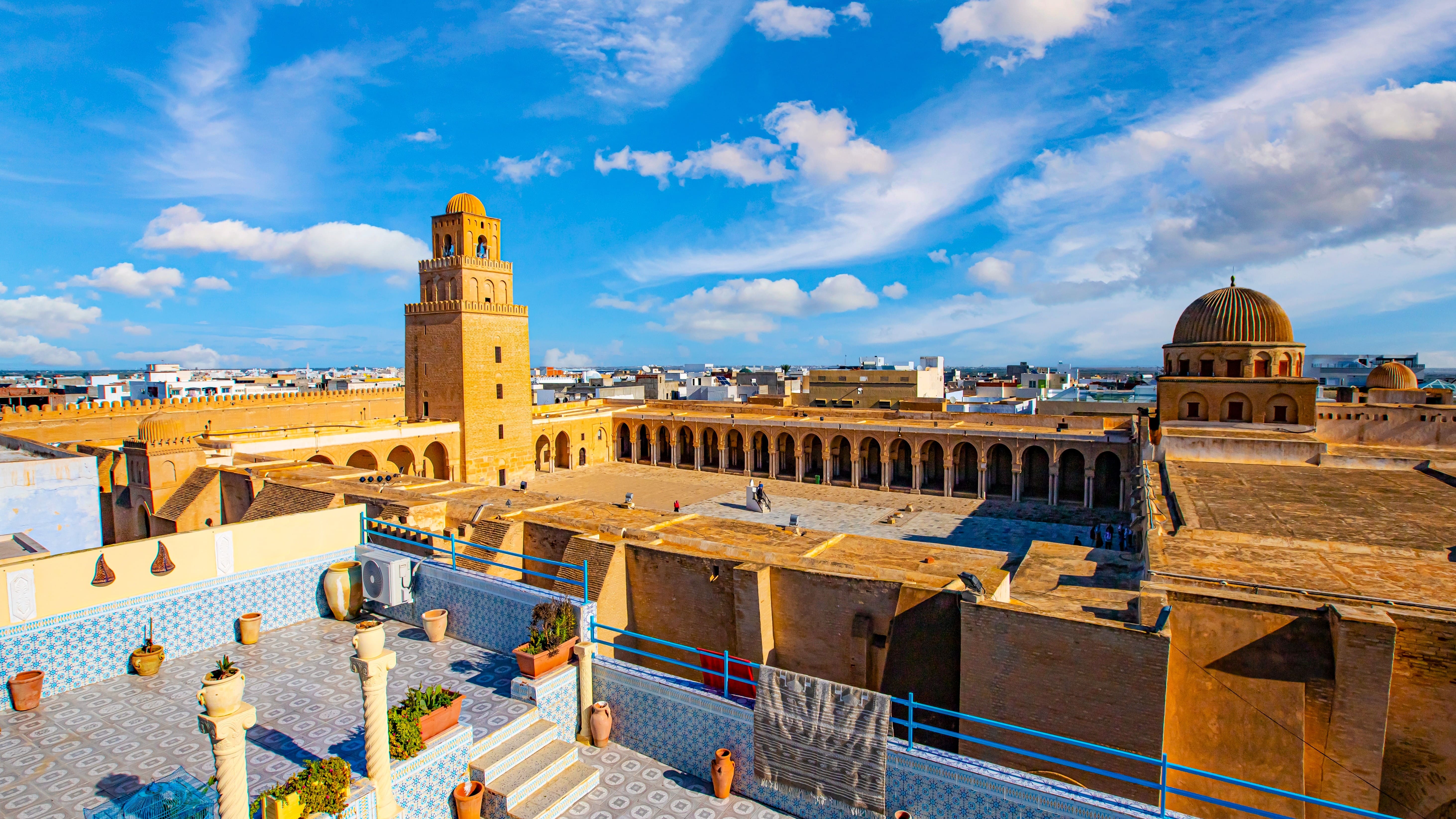
Beyond the medina lies the Great Mosque of Kairouan. Even if you're non-Muslim, you can enter the courtyard and glimpse the prayer hall. You can also climb the minaret, whose design was inspired by the Lighthouse of Alexandria. This 9th-century structure captivates through its austere elegance. Kairouan's other emblematic monument is the magnificent Barber's Mosque (zaouïa Sidi Saheb), which is considerably more ornate. Vibrantly colored tilework dazzles in the expansive courtyards. Slightly outside the city, you'll find the Raqqada Museum, which houses gold coins, ancient ceramics, and Quran manuscripts dating to the earliest centuries following Kairouan's foundation.
The region surrounding Kairouan offers abundant activities—from hiking to birdwatching on salt lakes, to hunting and cave exploration in the mountains.
Take home a memory of your stay
In Kairouan, the carpet is truly an institution. You'll find them everywhere. Flat-weave or thick hand-knotted carpets, geometric patterns or stylized figures (people, animals), chair covers or mergouem… There's an extensive array of carpets to choose from as souvenirs. Of course, other crafts are available—pottery, leather goods, copper work, and more. If you'd like to take home delightful treats, discover the delicious date pastries called maqroudh!
Practical Information
Climate in Kairouan
Tunisie generally enjoys a Mediterranean climate, but Kairouan, due to its inland location 70 km from the coast, experiences slightly hotter temperatures than the littoral. Year-round, average temperatures range between 17°C and 38°C. Be aware that heat can be intense in July and August. The rainy season includes September, October, and December. Given the climate, the best months for a vacation in Kairouan are April, May, September, and October.
Numerous bus lines and shared taxis serve Kairouan. From Tunis, take the A1 highway heading south toward Enfidha, then take the P2 road southwest. If traveling by air, the nearest airports are Monastir Airport and Enfidha-Hammamet Airport, both situated approximately 60 kilometers from Kairouan.
The medina is a pedestrian zone. Outside the ramparts, you can travel by car or taxi. It's quite easy to find parking near major sites such as the Barber's Mosque or the Aghlabid Basins.
What to do in Kairouan?
- Explore the Kairouan medina
- Visit the Aghlabid Basins site
- Admire the Great Mosque of Kairouan and its minaret
- Discover traditional carpet-making in the souks
- Taste maqroudh date pastries, and more
Attractions in Kairouan
Mosquée du Barbier (Zaouïa de Sidi Sahbi)
La Mosquée du Barbier, ou Zaouïa de Sidi Sahbi, abrite le mausolée d'un compagnon du Prophète dans la médina de Kairouan. Ses cours revêtues de zelliges et ses stucs ciselés en font l'un des décors les plus raffinés de Tunisie.
Grande Mosquée de Kairouan (Mosquée Okba)
Fondée en 670 par Okba ibn Nafi et agrandie sous les Aghlabides, la Grande Mosquée de Kairouan est l'un des monuments islamiques les plus anciens d'Afrique. Minaret carré, colonnes antiques et mihrab du IXe siècle en font un site UNESCO exceptionnel.
Want to discover this destination?
Our local advisors design your tailor-made trip.