El Jem
El Jem
Located 60 km from Sousse, El Jem is home to the fourth largest amphitheatre of the Roman Empire. Complete guide: visiting, access, tips and best time to visit.
Situated roughly sixty kilometres from Sousse, El Jem embodies the profound connection between Tunisie and the Roman Empire. An imposing colosseum, villas of aristocrats, an ancestral mosaic tradition… Discover the heritage of this jewel of the Sahel.
History
El Jem's history reaches back to the Phoenician era. The city was founded by the Punics, but it was particularly under the reign of Roman emperor Hadrian that it flourished. Declared a Roman colony from the Caesarean period, it gained the status of "Municipia libera" under Septimius Severus, then was annexed to the province of Byzacena. Called Thysdrus by the Romans, El Jem benefited from the region's strong agricultural productivity. Emperors Vespasian and Titus subsequently supplied it with water.
In the 2nd century, the city became a major crossroads; six Roman roads served it. Its agricultural market thrived and according to Gilbert Charles-Picard, Thysdrus was considered the "Oil Capital" of Byzacena.
The Revolution of 238: A Pivotal Turn
At the dawn of 238 AD, Thysdrus became the subject of a dispute that would shake the history of the Roman Empire. The levy of new taxes sparked an uprising. The inhabitants of the city and surrounding countryside rose up against the procurator of Emperor Maximinus Thrax. After the procurator's death, the rebels elevated Gordian, an elderly pro-consul of Africa passing through Thysdrus, as emperor. With his son Gordian II, the new sovereign marched to Carthage where he staged his adventus.
It was not long before Capelianus, legate of Numidia, violently suppressed the revolution. Yet the Roman Senate and several provinces supported and recognised the lineage, so the conflict escalated into civil war and a crisis within imperial power. Ultimately, Gordian III ascended to the throne.
Discovering El Jem
Its geographical position greatly contributed to its development. Ideally situated between the coast and the interior, the city has long been a thriving commercial crossroads, with strong agricultural potential, between the West and the Maghreb. On the road leading there, you will traverse vast stretches of farmland. Then, as you approach the city, a majestic colosseum materialises on the horizon…
Welcome to Tunisia's Rome!
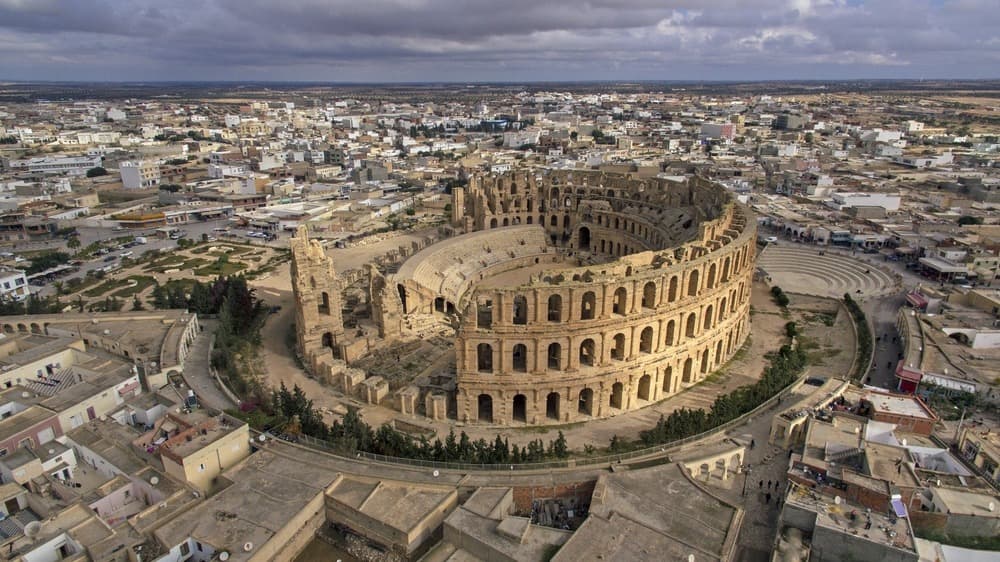
The Romans left a remarkable heritage in the city. Time and sand have patinated most of the monuments, certainly, but the El Jem Amphitheatre remains as grand and captivating as ever.
The El Jem colosseum is among the must-see attractions when visiting Tunisie. Inscribed on the UNESCO World Heritage list since 1979, it ranks among the oldest and finest preserved Roman creations in the world. Construction began in 230 and took eight years. During its active period, the amphitheatre had a seating capacity of 30,000 spectators, making it the fourth largest amphitheatre of the Empire. It spans 122 m wide and 149 m long, rising to 40 m high. Gladiator combats, wild animal spectacles, criminal executions and more—numerous events took place there in antiquity.
Climb to the upper levels to enjoy the splendid vista over the city and its surroundings. While in the lower sections, you will find the ancient gladiators' changing rooms, as well as the cages of wild animals. Unlike Rome's amphitheatre in Italy, the site receives few visitors, which is fortunate, as you will have all the time to explore the ruins undisturbed and imagine the scenes that unfolded here in the past.
Every summer since 1985, the El Jem Amphitheatre has hosted symphonic music concerts beneath a starlit sky.
Other Sublime Remains to Explore
With a single entrance ticket, continue your journey through time in another part of the city. Venture into the ancient villas of El Jem's wealthy class. Visit the villa "Africa", which once belonged to an aristocrat and is now considered the finest residence of Roman Africa. To find souvenirs, explore the craftsmen's shops scattered around the colosseum. Let yourself be drawn in by paintings, friezes and furniture crafted using ancient mosaic techniques.
Practical Information
Climate
El Jem experiences short, intensely hot and stifling summers. Conversely, winters are long and cold, with considerable wind. Throughout the year, temperatures range between 7°C and 34°C (rarely dropping below 3°C or exceeding 38°C). Given the climate, the best time to spend a holiday in El Jem runs from mid-June to mid-September.
Train is a practical option for reaching El Jem. From Tunis, the journey is brief. You can depart early in the morning, explore El Jem and catch an afternoon train back to the capital.
If you prefer to travel by car, from Tunis and Sousse, take the A1 motorway heading south. At interchange 19, branch onto road RR 87, heading south-east, which will lead you to El Jem.
El Jem is not very large. All attractions are within walking distance.
What to Do in El Jem?
- Explore the ruins of the El Jem Amphitheatre
- Visit the splendid villa "Africa"
- Discover the mosaic tradition in craftsmen's workshops
- Wander through the quiet, dusty streets of the city
- Attend the International Symphonic Music Festival of El Jem in summer, and more.
Want to discover this destination?
Our local advisors design your tailor-made trip.