Chemtou
Chemtou
Just 20 km from Jendouba, Chemtou conceals 80 hectares of Numidian and Roman remains, and the famous yellow marble that once adorned imperial palaces.
Spanning over 80 hectares in northwestern Tunisia, Chemtou is an ancient site that contains the remains of Simitthu, a city that belonged to the province of Africa Proconsularis during the Roman Empire. This mythical city sits at the crossroads of two major routes: one connecting Carthage to Annaba, and another linking Tabarka to Le Kef. It housed one of the most precious marbles of the Roman Empire, the ancient yellow marble quarried from its sites, which made it a celebrated city.
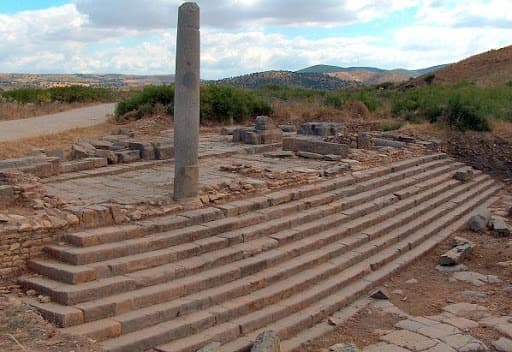
Chemtou represents an archaeological site containing remains spanning 1,500 years. Archaeological excavation campaigns in the late 1960s brought to light several elements of this ancient city, including a pathway to Thabraca, used to transport marble to the Mediterranean Sea. Like any Roman city, temples, bathhouses, workers' dwellings, an aqueduct, and an amphitheater have been identified.
History of Chemtou
Known for marble extraction, Chemtou represented an imperial monopoly during the Roman Empire. Since prehistory, the inhabitants of the region have drawn their wealth from the agricultural fertility of the Medjerda Valley.
In the 5th century BC, it was conquered by the Numidians. With the Numidian-Punic settlement, the small city began to develop thanks to its strategic location at the crossroads of two main routes. Commercial exchanges existed with the Mediterranean basin, leading to the systematic export of giallo antico. Chemtou stood out through Punic cultural influence.
At the beginning of Roman colonization in 27 BC, marble exploitation began under the reign of Augustus. High Roman society considered ancient yellow marble a luxury material. The Italians did likewise, calling it giallo antico. This type of stone was used for majestic imperial constructions throughout Rome.
The city developed alongside the growth of the quarries. It reached its peak during the reign of the Severans, when it underwent monumentalization. After obtaining a bishopric seat, Chemtou experienced a phase of Late Antiquity, leading into the Middle Ages. The beginning of the Aghlabid and Fatimid rule was marked by the arrival of Arabs who populated the region in the 9th and 10th centuries.
Essential Remains to See
On the occasion of a visit to Chemtou, you will discover several remarkable remains. Do not miss the Roman Bridge over the Medjerda. This bridge allowed crossing the Medjerda to reach Chemtou. This impressive architecture is the largest construction of its kind in North Africa. It is built with various materials: greenish limestone blocks, yellow rocks, and gray marble.
You can observe on the site installations from a marble works dating back to the early 20th century. These have been preserved and classified as the first elements of industrial archaeology.
In the Chemtou Museum, you can discover remains from the Numidian sanctuary with a reconstruction of its façade. During the Roman period, this temple was dedicated to the god Saturn. It also contains important fragments of architectural decoration from the 2nd century BC, as well as a model of a millstone that demonstrates how a turbine mill functioned—the last monument built on the left bank of the bridge.
Ruins of cisterns and aqueducts are still visible on the site. The city possessed an urban aqueduct that supplied water to public and private baths, as well as to wells and public fountains.
Want to discover this destination?
Our local advisors design your tailor-made trip.