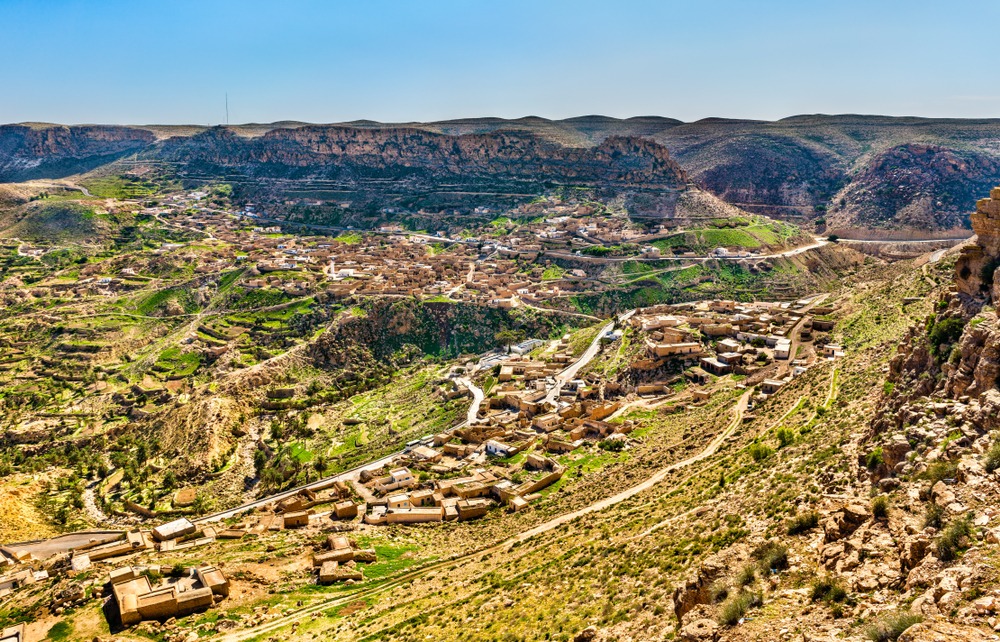
Zaghouan
At the foot of djebel Zaghouan, this mountain town preserves a 2nd-century Roman nymphaeum, starting point of the Carthage aqueduct, and a quiet Ottoman medina just an hour from Tunis.
Zaghouan is a mountain town situated roughly sixty kilometres south-west of Tunis, at the foot of djebel Zaghouan. Known for its abundant water sources that fed Carthage through a Roman aqueduct, it combines ancient heritage, Ottoman architecture and unspoiled nature. It's a understated and authentic stop, far removed from the hustle of coastal resort circuits.
Practical information at a glance
- Access from Tunis: approximately 60 km by road; shared taxis (louages) from Bab Alioua bus station.
- Recommended duration: half a day to a full day.
- Dress code: modest dress recommended for visiting the mosque and residential quarters.
- Altitude: the town sits at elevation; bring comfortable shoes for the sloping alleyways.
What to see
The Roman Temple of Waters is the most prominent monument: a semi-circular nymphaeum from the 2nd century built against the cliff face, where springs flowed to feed the Carthage aqueduct. The town centre preserves a modest medina with courtyard houses, an Ottoman mosque and paved alleyways. Djebel Zaghouan, the highest peak in northern Tunisie at 1,295 m, dominates the landscape.
History and context
Under the Roman Empire, Zaghouan — Ziqua — was a prosperous city thanks to its springs. The aqueduct built under Hadrian conveyed water over more than 130 km to Carthage, one of the longest in the ancient world. The town subsequently experienced Byzantine, Arab and Ottoman periods, each leaving traces in its urban fabric.
Highlights of your visit
The Temple of Waters (Roman nymphaeum)
Built against the rock face, this semi-circular sanctuary houses niches where the springs were venerated. The state of preservation is remarkable. A central basin collected water before it departed along the aqueduct. The entrance opens onto a well-maintained garden with views across the mountain.
The Carthage aqueduct
Isolated arches of the Roman aqueduct remain in the plain between Zaghouan and Tunis. Some sections are visible from the main road. This vestige speaks to the sophistication of Roman hydraulic engineering in North Africa.
Djebel Zaghouan
The massif offers accessible hiking trails from the town. The pine and cork-oak forest shelters diverse wildlife. On clear days, views extend all the way to the Gulf of Tunis.
The medina and mosque
The Ottoman mosque in the town centre, understated and well-preserved, is surrounded by quiet alleyways. The weekly souk enlivens the main square and offers local produce — olive oil, aromatic herbs.
Etiquette and visiting rules
- Shoulders and knees covered when entering the mosque.
- Remove shoes before entering the prayer space.
- Avoid visits during Friday prayer times.
- Ask permission before photographing locals.
Photography tips
The nymphaeum faces east: morning light is ideal for photographing the arches without backlighting. Late afternoon brings a golden glow to the cliff face. For the aqueduct in the plain, sunrise or sunset creates long shadows that accentuate the arches.
Location and access
Zaghouan sits in the governorate of the same name, approximately 60 km south-west of Tunis. Shared taxis from Bab Alioua are the most practical option without a car. By car, the road crosses agricultural plains before climbing towards the town. The Temple of Waters site is reachable on foot from the centre in minutes. Disabled access to the nymphaeum is limited due to paving and elevation changes.
In the surrounding area
- Thuburbo Majus — well-preserved Roman city roughly thirty kilometres away, with forum, capitol and baths.
- Oudna (Uthina) — Roman archaeological site between Zaghouan and Tunis, amphitheatre and in-situ mosaics.
- Medina of Tunis — approximately one hour's drive away, listed as Unesco World Heritage.
Frequently asked questions
Spring (March-May) and autumn (September-November) are the most pleasant seasons. Summer can be hot in the plain, but the mountain stays cool. In winter, djebel Zaghouan occasionally receives snow.
Yes, the two sites are roughly thirty kilometres apart. By car, one day is sufficient to visit the Zaghouan nymphaeum in the morning and Thuburbo Majus in the afternoon.
The lower trails are accessible to hikers in reasonable fitness. The summit at 1,295 m requires endurance and appropriate gear. A local guide is recommended for less-marked routes.
Photography is generally allowed at the nymphaeum site. Inside the mosque, ask permission before taking out your camera.
Shared taxis (louages) depart regularly from Bab Alioua bus station in Tunis. It's the most common and economical means. The journey takes roughly one hour depending on traffic.
Want to discover this destination?
Our local advisors design your tailor-made trip.