Sbeitla
Sbeitla
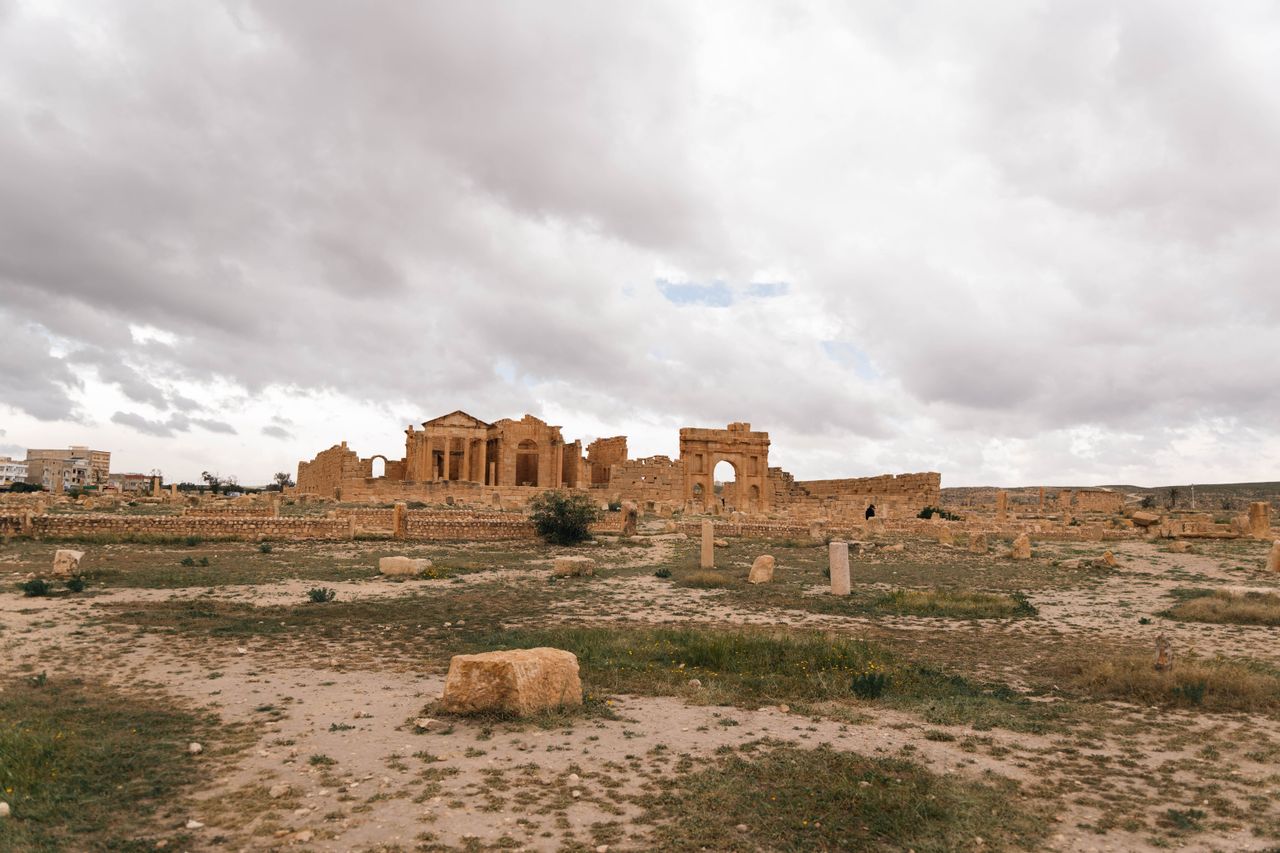
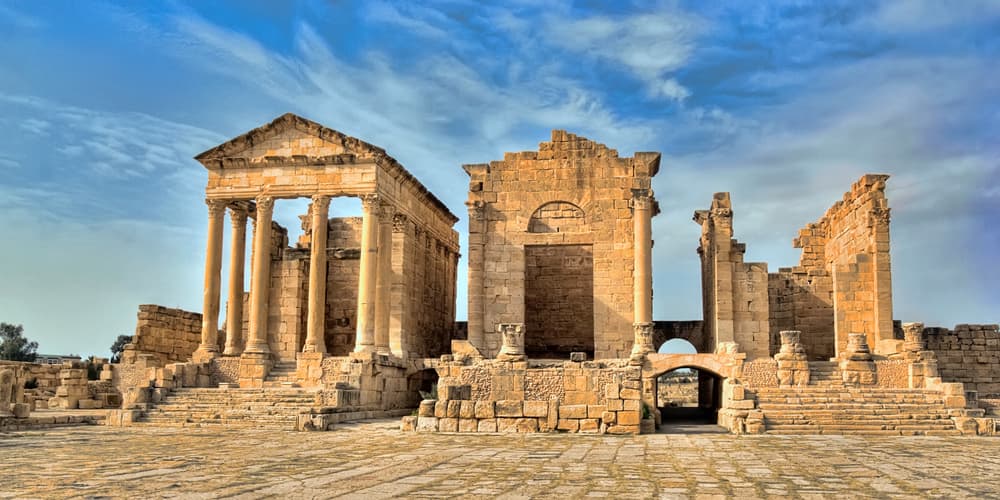
Sbeitla is home to ancient Sufetula, one of the best-preserved Roman forums in North Africa, featuring three aligned Capitoline temples, the Arch of Antoninus Pius, and early Christian basilicas.
Sbeitla — ancient Sufetula — is a city in central-western Tunisia, in the Kasserine Governorate. It houses one of the best-preserved Roman forum complexes in North Africa: three Capitoline temples standing side by side, a fortification wall, public baths, and Christian basilicas, all still rising from a landscape of golden steppe.
Quick Facts
- Admission: paid entry (archaeological site managed by the INP — Institut National du Patrimoine)
- Duration: 2 to 3 hours to explore the entire site
- Dress code: no restrictions, but closed-toe shoes recommended (uneven terrain)
- Access: Sbeitla is accessible from Kasserine (roughly 35 km away) or from Kairouan via the national road
- Accessibility: limited — ancient paved floors and unimproved terrain
What to See
The heart of the site is the Roman forum, enclosed on three sides by the temples of Jupiter, Juno, and Minerva — a configuration unique in the Roman world. The triumphal arch of Antoninus Pius marks the monumental entrance. Farther on, the public baths, theatre, and several early Christian basilicas complete the visit.
History and Context
Sufetula was founded in the 1st century CE and thrived as an agricultural city — olive oil from the region supplied part of the empire. In 647, the Battle of Sbeitla pitted the Byzantines against Arab armies; the defeat of the patrician Gregory opened the way to the Islamic conquest of the Maghreb. This convergence of civilizations — Roman, Byzantine, Christian, and Islamic — is still readable in the stones of the site.
Highlights of Your Visit
The Three Capitoline Temples
Dedicated to Jupiter, Juno, and Minerva, these three temples aligned on a single podium make up Sbeitla's singular distinction. No other known Roman city presents this tripartite arrangement. The Corinthian columns remain largely intact.
The Arch of Antoninus Pius
Erected in the 2nd century CE, this three-bay arch marks the entrance to the forum. Its proportions and state of preservation make it one of the most legible Roman arches in Tunisia.
Early Christian Basilicas
Several basilicas from the 4th–6th centuries testify to the vitality of Christian Sufetula before the Arab conquest. Some preserve fragments of mosaics and baptismal fonts.
The Public Baths
The public baths, though only partially excavated, reveal the scale and organization of the city: the frigidarium, tepidarium, and caldarium are still identifiable in the ground plan.
Photography Tips
Morning light (before 10 a.m.) is ideal: it strikes the temple columns head-on and avoids harsh shadows. In late afternoon, the stone takes on a warm ochre hue. No known photographic restrictions apply to the site. A wide-angle lens lets you frame all three temples together from the forum.
Location and Access
Sbeitla lies approximately 35 km northeast of Kasserine, the governorate's capital. Regular louages (shared taxis) connect the two cities. From Tunis, the journey passes through Kairouan or via the motorway to Enfidha, then along national roads. The archaeological site sits on the immediate edge of the modern town, easily recognizable.
Nearby
- Kasserine — a transit hub and departure point for the gorges and highlands of central-western Tunisia.
- Djebel Chambi — Tunisia's highest peak, accessible from Kasserine, for high-altitude hiking.
- Kairouan — a great Islamic holy city, a few hours' drive away, home to the Grand Mosque and a UNESCO-listed medina.
- Haïdra (Ammaedara) — another Roman site in Kasserine Governorate, less frequented, with a triumphal arch and mausoleums.
Frequently asked questions
Spring (March–May) and autumn (September–November) offer pleasant temperatures. Summer is very hot in this interior steppe region; bring water and sun protection if visiting in July–August.
Allow 2 to 3 hours to explore the forum, temples, arch, baths, and basilicas at a relaxed pace. A half-day is sufficient for most visitors.
It's feasible but tight. The distance between the two sites exceeds 100 km. Better to spend a night in Sbeitla or Kasserine to visit both without rushing.
Local guides are sometimes available at the site entrance. For an in-depth visit, it's best to book an English-speaking guide through a local agency before you go.
Yes, photography is permitted on the site. No particular restrictions are noted for personal cameras.
Accessibility is limited: Roman paving, thresholds, and unimproved terrain make wheelchair navigation difficult over much of the site.
Want to discover this destination?
Our local advisors design your tailor-made trip.